

The Italian VAT Consolidated Act 2027 (Legislative Decree No. 10 of 19 January 2026) applies from 1 January 2027 and brings together, in a single organic text of 171 articles, the provisions of DPR 633/1972, Decree-Law 331/1993 and many other measures, which until now have formed the basis of Italian VAT law. It is not a reform of substance: rates, exemptions and application rules remain substantially the same. What changes is almost every legal reference currently cited on invoices, in contracts and in accounting software — with very concrete practical consequences for businesses and professionals.

To be clear: the Consolidated Act does not change the rules of the game, but it changes the language in which we have described them for over half a century. Since 1972, anyone working with VAT has learned to associate an article number — art. 10, art. 21, art. 41 — with a whole package of obligations, exceptions and practical consequences, almost as an automatic reflex.
By gathering into one organic framework rules previously scattered across DPR 633/72 and Decree-Law 331/93, the new text is, on paper, a simplification. In the daily practice of operators and software, however, it means unlearning a mental association built up over 53 years — an impact that is far from trivial, even when the content of the rules does not change by a comma.
In brief
- Legislative Decree No. 10 of 19 January 2026 has been in force since 31 January 2026, but applies to transactions carried out from 1 January 2027 (art. 171).
- The text has 18 titles, 171 articles and 4 tables.
- VAT rates and the substantive rules of the tax do not change: what changes are the legal references to be cited on invoices and in management software.
- Only the provisions listed in art. 170 are repealed: neither DPR 633/72 nor Decree-Law 331/93 is cancelled in full.
- The Natura codes stay the same: what changes is the article of law cited in the invoice wording.
- Until 31 December 2026 you keep citing DPR 633/72.
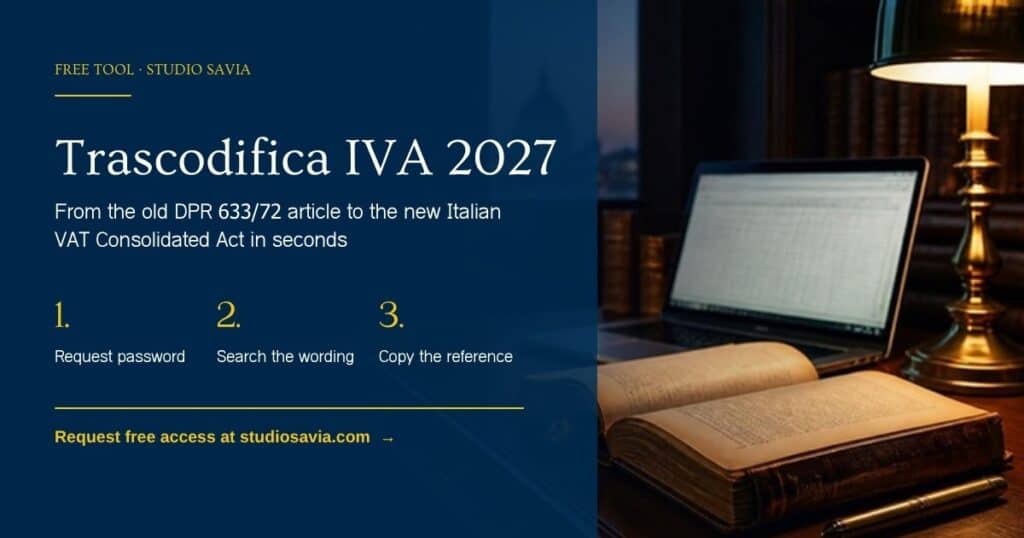
- To find the new reference for the wording you use today you can use Trascodifica IVA 2027, Studio Savia’s free tool (in Italian).
Read also — For the big picture of the new code (18 titles, replaced laws and old-to-new article table) see our guide Italian VAT Consolidated Act: what it is, how it is structured and what changes from 2027.
In this article
What the Italian VAT Consolidated Act 2027 is and why it exists
The Italian VAT Consolidated Act 2027 stems from the tax reform delegation (Law 111/2023), which instructed the Government to reorganise tax legislation into a series of organic consolidated acts — one for VAT, one for income taxes, one for compliance and assessment, and so on. The text was published as Legislative Decree No. 10 of 19 January 2026 in the Gazzetta Ufficiale (Official Gazette) No. 24 of 30 January 2026 (Ordinary Supplement No. 4), and has formally been in force since 31 January 2026.
Its provisions, however, apply to transactions carried out from 1 January 2027 (art. 171), the date from which the provisions listed in art. 170 are repealed: entire blocks of articles of DPR 633/1972 and Decree-Law 331/1993, some rules of Legislative Decree 127/2015 and numerous other measures. Articles that do not appear in the list are not affected by this repeal.
Until 31 December 2026, therefore, everything stays as it is today: invoices continue to cite DPR 633/72. From 1 January 2027 onwards, the same transactions will have to be traced back to the articles of the new Consolidated Act.
What really changes: the renumbering of articles
The most concrete change for those who issue invoices is the numbering. The articles of DPR 633/72 that are cited daily in invoice wording are renumbered almost in full. Some of the most frequent examples:
- exempt transactions, currently art. 10 DPR 633/72, become art. 37 of the Consolidated Act;
- VAT deduction, currently art. 19, becomes art. 56;
- the articles on invoicing (21 and 21-bis) become arts. 72 and 73;
- the reverse charge, currently art. 17, becomes art. 64;
- the margin scheme (art. 36, Decree-Law 41/1995) is now governed by arts. 143 to 148;
- intra-Community supplies (art. 41, Decree-Law 331/1993) become intra-Union supplies governed by art. 39.
The annexed tables identifying goods and services subject to reduced rates are also reorganised: the current Table A (parts I, II, II-bis and III) is replaced by a single Table A in four parts (I for agricultural and fishery products, II, III and IV for the 4%, 5% and 10% rates respectively), plus tables B, C and D. Rates do not change, but the numbering of individual entries does: anyone applying reduced rates will have to recode entry by entry.
One special case: some letters of art. 64, paragraph 6 (reverse charge on mobile phones, electronic products and the energy sector) are effective only for transactions carried out up to 31 December 2026, unless extended. Those who use these codes will need to check in good time whether the measure is extended.
Which article of the Consolidated Act matches the wording you use today?
With Trascodifica IVA 2027 you type the old wording, the DPR 633/72 article or the Natura code and immediately get the new reference. It is free: you only need a password, sent by email. The tool is in Italian.
Try Trascodifica IVA 2027 for free →For a full comparison between current law and the Consolidated Act, see the paper by the working group of the Turin Order of Chartered Accountants (ODCEC Torino), in which Enrico and Fabio Savia took part: VAT correlation table: current law and Consolidated Act (in Italian).
Invoices with the old references: what the Consolidated Act says
Paragraph 3 of art. 170 contains a link between old and new rules: unless the Consolidated Act provides otherwise, and outside cases of repeal by incompatibility, when laws, regulations, decrees or other measures refer to expressly repealed provisions, the reference is deemed to be made to the corresponding provisions of the Consolidated Act.
It therefore concerns references contained in legislative acts and measures. It says nothing expressly about the content of invoices: for transactions carried out from 1 January 2027 the prudent choice is to cite the new article directly, without relying on this link. Invoices for transactions carried out up to 31 December 2026 follow the rules in force at that date.
For this reason it is worth updating in good time the VAT codes in your management software and your invoice templates, following any clarifications from the Italian Revenue Agency (Agenzia delle Entrate) and the new technical specifications for electronic invoicing. The “Natura” codes (N1, N2, N3, N4 and so on) do not change as a result of the renumbering: what changes is the article of law cited in the wording. Any update to the codes themselves would require new technical specifications.
What to do between now and 2027: a practical checklist
- Map the VAT reasons most used in your business: which articles of DPR 633/72 appear most often on issued invoices (exemptions, non-taxable transactions, reverse charge, special schemes).
- Update your invoicing software, or check with your supplier when the new references will be available in the pre-filled templates.
- Train the administrative staff who prepare invoices, to avoid mistakes during the transition period.
- Check the reduced rates applied, because the numbering of table entries changes even when the rate stays the same.
- Keep an eye on the 31 December 2026 deadline for the reverse charge on mobile phones, electronics and energy, pending a possible extension.
You do not need to start from scratch to check your invoice wording: with Trascodifica IVA 2027 you check the descriptions you use most and copy the new reference, at no cost.
A practical example with the Italian VAT Consolidated Act 2027
A financing transaction, currently invoiced as “VAT-exempt transaction under art. 10, paragraph 1, no. 1, DPR 633/72”, will have to be indicated from 1 January 2027 as “VAT-exempt transaction under art. 37, paragraph 1, letter a), Legislative Decree 10/2026” — same exemption, same Natura code N4 in the electronic invoice, different legal reference.
The Italian VAT Consolidated Act 2027 therefore introduces no new substantive rules, but requires a formal update that involves invoicing, contracts and management software. Preparing in good time, before the 1 January 2027 deadline, avoids having to intervene in an emergency close to the changeover.
Studio Savia follows the evolution of the Italian VAT Consolidated Act 2027 and can support businesses and professionals in checking the most frequently used invoicing codes and in updating legal references ahead of 2027. Contact us for a tailored review.
Natura codes and the Italian VAT Consolidated Act 2027: where to start when updating invoice wording
In the electronic invoice, each transaction without VAT carries a Natura code: N1 for excluded transactions, N2 for non-subject, N3 for non-taxable, N4 for exempt, N5 for the margin scheme, N6 for the reverse charge, N7 for VAT paid in another EU Member State. The code stays the same, but the wording on the invoice must cite the article of law, and that changes with the renumbering.
That is why it is best to start from the Natura code rather than the old article. You choose a type of transaction, for example exempt transactions N4, and check all the related wording against the new reference. This is the criterion by which the entries in Trascodifica IVA 2027 are grouped, and it is the quickest way not to forget anything in your software.
Trascodifica IVA 2027: the free tool that makes life easier for taxpayers
To speed up exactly this checking work, Studio Savia has created Trascodifica IVA 2027, a free application on the site that lets you search for the wording, article or Natura code currently in use and immediately find the correct reference under the new Consolidated Act. The tool is free but access is restricted, and it is available in Italian only: to use it, simply request the access password (Italian page) by leaving your email address — the password is sent automatically within moments.
Free access
Get your Trascodifica IVA 2027 password
Fill in your name and email on the request page: you receive a link to confirm your address and then your personal password. The form and the tool are in Italian.
Request the free password →Italian VAT Consolidated Act 2027 and your accounting software: organising the recoding of VAT codes
The hardest part is not reading the Italian VAT Consolidated Act 2027 but moving it into the accounting software. In almost every invoicing system each transaction without VAT is linked to an internal VAT code carrying three pieces of information: the rate or the reason for exclusion, the Natura code sent to the SdI exchange system, and the wording printed on the invoice with the legal reference. The renumbering only touches the third element, but that is the one that appears on every document issued.
The safest method is a census: export the complete list of VAT codes in use, drop those never used in recent years and, for each remaining one, note the current reference and the corresponding article of the Italian VAT Consolidated Act 2027. For a company with ten or fifteen active codes the job takes a few hours; for a firm managing dozens of sets of accounts it pays to prepare a standard table and apply it to every client.
| Transaction | Reference until 31/12/2026 | Reference from 1/1/2027 | Natura code |
|---|---|---|---|
| Exempt transactions | art. 10 DPR 633/72 | art. 37 Legislative Decree 10/2026 | N4 |
| Reverse charge | art. 17 DPR 633/72 | art. 64 Legislative Decree 10/2026 | N6 |
| Intra-EU supplies | art. 41 Decree-Law 331/93 | art. 39 Legislative Decree 10/2026 | N3.2 |
| Margin scheme | art. 36 Decree-Law 41/95 | arts. 143-148 Legislative Decree 10/2026 | N5 |
| Deduction of input VAT | art. 19 DPR 633/72 | art. 56 Legislative Decree 10/2026 | — |
| Invoicing | arts. 21 and 21-bis DPR 633/72 | arts. 72 and 73 Legislative Decree 10/2026 | — |
The references in the table are the most common ones; every other code has to be checked entry by entry, which is exactly what Trascodifica IVA 2027 lets you do in a few minutes starting from the Natura code.
Not only invoices: contracts, quotes and terms of sale
The Italian VAT Consolidated Act 2027 also changes references outside the accounting software. Multi-year contracts, standard quotes, the general terms of sale of an e-commerce site, declarations of intent, credit note templates and internal procedures often quote “article 10” or “article 17” in full. For contracts already signed, the bridging rule in article 170(3) means the reference is read as pointing to the corresponding new provision; for templates that will be used from 2027 it is better to update the text, so as not to carry references to repealed rules for years.
The operational timeline towards 1 January 2027
The timeline is set by article 171: the Italian VAT Consolidated Act 2027 applies to transactions carried out from 1 January 2027, and the time of supply is still determined by the ordinary rules, namely delivery or dispatch for goods and payment for services.
This creates a grey zone around the turn of the year: goods delivered in December 2026 but invoiced in January 2027 are a 2026 transaction and cite DPR 633/72, while a service paid in January 2027 is a 2027 transaction and cites the Consolidated Act. The software must handle both wordings for a few weeks and staff must know which one to use.
- By autumn 2026: census of the VAT codes in use and a check with the software provider on whether the update will be automatic or manual.
- November and December 2026: loading the new wordings in a test environment, training the administrative staff, updating contracts and templates.
- 31 December 2026: last day for transactions with the current references and, unless extended, expiry of the reverse charge on mobile phones, electronics and energy.
- 1 January 2027: transactions carried out from this date cite the Italian VAT Consolidated Act 2027; documents for 2026 transactions issued in January keep the old reference.
- Early 2027: sample checks of invoices issued and received, because suppliers may also cite the wrong references.
One last point concerns purchase invoices: from 2027 suppliers will also have to cite the Italian VAT Consolidated Act 2027, and in the first months there will be documents with old or imprecise references. A wrong legal reference should not in itself jeopardise the deduction if the transaction is correctly identified, but it is advisable to flag it to the supplier and, in doubtful cases, ask for a correcting note rather than accumulating non-compliant documents.
Frequently asked questions about the Italian VAT Consolidated Act
When does the Italian VAT Consolidated Act come into force?
The decree (Legislative Decree 10/2026) has formally been in force since 31 January 2026, but its provisions apply to transactions carried out from 1 January 2027 (art. 171). Until that date DPR 633/1972 remains valid.
Do I have to reissue invoices already issued with the old legal references?
Invoices for transactions carried out up to 31 December 2026 follow the rules in force at that date: the Consolidated Act applies to transactions from 1 January 2027. Paragraph 3 of art. 170 provides that references in laws, regulations and other measures to repealed rules are read as references to the corresponding rules of the Consolidated Act, but it does not regulate the content of invoices: for transactions from 2027 it is best to cite the new reference straight away.
Is it true that art. 10 of DPR 633/72 becomes art. 39 of the Consolidated Act?
No: it is a common mistake. The VAT exemption currently governed by art. 10 becomes art. 37 of the new Italian VAT Consolidated Act 2027. Art. 39 instead concerns intra-Union supplies (formerly art. 41, Decree-Law 331/1993).
Do VAT rates change with the Consolidated Act?
No. The Italian VAT Consolidated Act 2027 reorganises the numbering of articles and annexed tables, but the rates (22%, 10%, 5%, 4%) and the criteria for applying them remain unchanged.
What should I do concretely before 2027?
Map the most used VAT codes, update your management software and invoice templates, train administrative staff and, if you use the reverse charge on mobile phones, electronics and energy, check the 31 December 2026 deadline provided for by art. 64, paragraph 8. To speed up the mapping of the most used codes, Studio Savia offers the free tool Trascodifica IVA 2027 (restricted access, on request by email; available in Italian only).
Is DPR 633/72 repealed in full?
No. From 1 January 2027 only the provisions listed in art. 170 of Legislative Decree 10/2026 are repealed: for DPR 633/72 these are specific ranges of articles and tables A, B and C, and the same applies to Decree-Law 331/93. For each reference you use, check that it really falls within the list.
Do the Natura codes in electronic invoices change?
The renumbering of articles does not change them automatically: the code stays and the rule cited in the wording changes. Any changes to the codes would depend on new technical specifications from the Italian Revenue Agency. In Trascodifica IVA 2027 the entries are grouped precisely by Natura code.
Is there a free tool to move from the old VAT references to the new ones?
Yes: Trascodifica IVA 2027 by Studio Savia. You search for the wording, the DPR 633/72 article or the Natura code you use today and get the correct reference under the Italian VAT Consolidated Act 2027. The tool is free and in Italian; to access it you just request a password.
How do I get the Trascodifica IVA 2027 password?
Fill in the form on the access request page with your name and email: you receive a link to confirm the address and then your personal password. There are no fees or subscriptions.
Sources
- Legislative Decree no. 10 of 19 January 2026 – Consolidated VAT Act (Normattiva, in Italian)
- Official Gazette no. 24 of 30 January 2026, Ordinary Supplement no. 4
- Law no. 111 of 9 August 2023 – Delegation to the Government for the tax reform (Normattiva)
Unsure how to set up the new wordings in your accounting software? Contact Studio Savia: we will review your most used VAT codes together and prepare the recoding table for 2027.
Italian VAT Consolidated Act 2027
Want your VAT codes checked before 2027?
Leave your details: we will get back to you for a personalised review of your invoice wordings and of the transition to the Consolidated Act.
Prefer to talk it through? Call the firm on +39 011 349 0809 (Mon–Fri 8:30 am–1:00 pm / 2:00–5:30 pm CET) or message us on WhatsApp.